
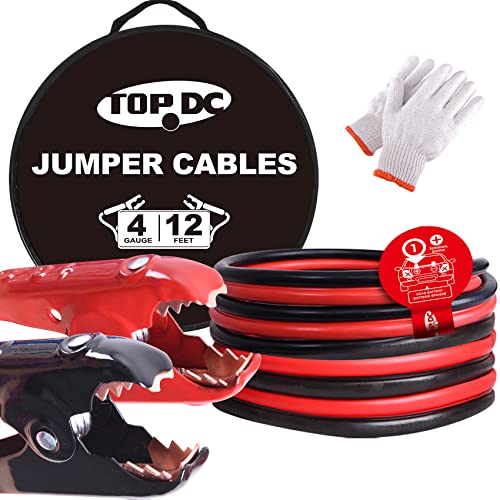
TOPDC Pure Copper 4 Gauge 12 Feet Jumper Cables UL Listed for Car, SUV and Trucks Battery, Heavy Duty Automotive Booster Cables for Jump Starting Dead or Weak Batteries with Carry Bag and Gloves
Product Description
TOPDC Pure Copper 4 Gauge 12 Feet Jumper Cables UL Listed for Car, SUV and Trucks Battery, Heavy Duty Automotive Booster Cables for Jump Starting Dead or Weak Batteries with Carry Bag and Gloves
- SAFE AND RELIABLE: UL listed heavy-duty battery jumper cables make you physically and environmentally safer and more reliable
- OUTSTANDING PERFORMANCE: 100% copper wire 500A for outstanding electrical conductivity and power transfer
- DURABLE CABLES: 4Gauge 12FT. Tangle-free design. PVC insulated cables remain flexible at -40F/-40C to 167F/75C
- PACKAGE CONTENTS: Pure copper booster cable and safety gloves
This TOPDC booster cable is provided by UL listed factory.
Features:
1. Safe, reliable, The color coded cables help you avoid confusion with easy polarity identification.
2. Ideal for automotive, truck and farm applications etc.
3. 4 Gauge Booster Cable Kit
also includes a Non-woven bag, gloves, and safety glasses to make the job as safe and easy as possible.
4. COLOR CODED: Red (+), Black (-)
5. Don't worry about the springs in the clamps are too weak or do not clamp the battery posts as tightly as needed to transfer current. Test Intentions:
1. Low Temperature Test: To make sure the jacket material meets SAE or UL specifications for flexibility and high voltage leaks.
2. Dielectric Test: To test the resistance voltage of cable/clamp insulations, and ensure safety.
3. Aging (High Temperature) Test: To judge the aging performance of the insulation materials of the cable/clamp or others.
4. Ampacity Test: To judge the booster cable set rating performance.
5. Acid Exposure Test: To judge the acid resistance of the clamp plating.
6. Flame Test: To judge fire retardant properties of the cable insulation or clamp (usually plastic clamp).
7. Resistance Test: To judge the electric performance of the cable. To check the conductivity of the cable. To check the quality of the copper.
8. Pull-out Test: To test the connection (crimping) between the jaw and cable.
Technical Specifications
You might also like

TOPDC 100% Copper Jumper Cables 4 Gauge 20 Feet Heavy Duty Booster Cables with Carry Bag and Safety Gloves (4AWG x 20Ft)

Bucket Boss Cable Bag in Brown, 69000

Emgo 84-96306 6' Cycle Jumper Cable Set

RHINO USA Recovery Tow Strap 3" x 20ft - Lab Tested 31,518lb Break Strength - Heavy Duty Draw String bag Included - Triple Reinforced Loop End to Ensure Peace of Mind - Emergency Off Road Towing Rope

TOPDC 100% Copper Jumper Cables 6 Gauge 16 Feet Heavy Duty Booster Cables with Carry Bag and Safety Gloves (6AWG x 16Ft)

TEKTON Combination Wrench Set, 30-Piece (1/4-1 in, 8-22 mm) - Pouch | 90192

SELTERM 10 Pack 4 Gauge 4 AWG 3/8" Stud UL Heavy Duty Copper Crimp Lugs Welding Cable Bare Copper Eyelet Lug
CARTMAN Warning Triangle DOT Approved 3PK, Identical to: United States FMVSS 571.125, Reflective Warning Road Safety Triangle Kit

Impact Heavy-Duty Air-Cushioned Light Stand (Black, 9.5')

AiLi Voltmeter Ammeter Voltage Current Meter Voltmeter Ammeter 100V 350A Caravan RV Motorhome 999 AH