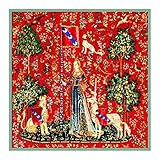

Orenco Originals The Smell Panel from The Lady The Unicorn Tapestries Counted Cross Stitch Pattern
Product Description
Orenco Originals The Smell Panel from The Lady The Unicorn Tapestries Counted Cross Stitch Pattern
- ★ This item is a Counted Cross Stitch Pattern that you will use to stitch to create a picture. It is NOT a finished product, it is a Pattern ★
- This is NOT A KIT. Floss and Fabric are NOT included. This purchase is for the pattern only. You must purchase any required Floss and Fabric separately.
- This pattern is charted for 14 grid/count fabric. Finished size will be 14 inches (196 stitches) by 14 inches (196 stitches).
- We provide two charts both printed in black ink on bright white 11" by 17" paper. Chart #1 is a single page overview chart. Chart #2 is a 4 page enlarged chart to work from.
- Orenco Originals is happy to email you a supply list detailing the DMC Floss and number of skeins needed to complete the project so you can buy or organize floss to start stitching once your pattern arrives; email us after you order
This is a pattern that is used to sew and to create a needlepoint or cross stitch picture. This is NOT a completed product. It is NOT a kit, it contains no floss or fabric. This chart was inspired by a Medieval tapestry. Tapestries have been used since at least Hellenistic times. Samples of Greek tapestry have been found preserved in the desert of Tarim Basin dating from the 3rd century BC. Tapestry reached a new stage in Europe in the early 14th century AD. The first wave of production occurred in Germany and Switzerland. Over time, the craft expanded to France and the Netherlands. In the 14th and 15th centuries, Arras, France was a thriving textile town. The industry specialized in fine wool tapestries which were sold to decorate palaces and castles all over Europe. Few of these tapestries survived the French Revolution as hundreds were burnt to recover the gold thread that was often woven into them. Arras is still used to refer to a rich tapestry no matter where it was woven. By the 16th century, Flanders, Brussels, and Enghien had become the centers of European tapestry production. In the 17th century, Flemish tapestries demonstrating intricate detail of pattern and color embodied in intricate compositions, often of monumental scale. In the 19th century, William Morris resurrected the art of tapestry-making in the medieval style at Merton Abbey. Morris & Co. made successful series of tapestries for home and ecclesiastical uses, with figures based on drawings by Edward Burne-Jones. Kilims and Navajo rugs are also types of tapestry work.